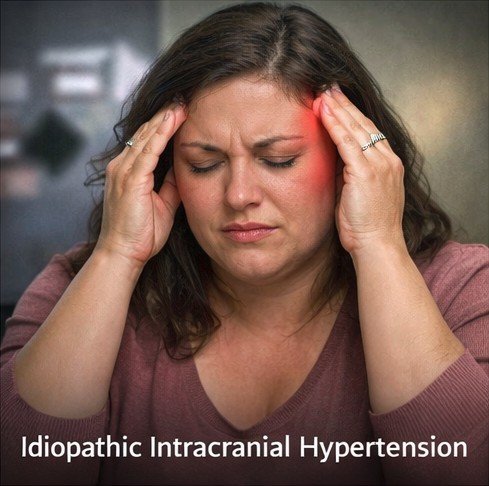
Idiopathic intracranial hypertension, abbreviated IIH and previously known as pseudotumor cerebri, is a syndrome of chronically elevated intracranial pressure occurring without an identifiable structural cause such as tumor, infection, vascular malformation, or obstructive hydrocephalus. It represents one of the few headache-causing conditions that poses a direct threat to long-term neurological function — specifically to vision — because the elevated intracranial pressure exerts continuous mechanical stress on the optic nerves, causing progressive optic nerve damage that can result in permanent visual field loss and potentially blindness if inadequately treated.
The condition predominantly affects women of reproductive age with obesity, a demographic in which annual incidence reaches approximately twenty per hundred thousand — a rate that has risen dramatically alongside global increases in obesity prevalence. Men, children, and individuals without obesity can also develop IIH, and these atypical presentations are associated with greater diagnostic delay and sometimes more aggressive courses. Increasing clinician awareness of IIH across primary care, neurology, and ophthalmology is essential to enable timely diagnosis and vision-preserving intervention.
Pathophysiology
The mechanisms generating elevated intracranial pressure in IIH remain incompletely characterized. The leading hypothesis implicates impaired absorption of cerebrospinal fluid at the arachnoid granulations — specialized structures that drain CSF from the subarachnoid space into the cerebral venous sinuses. When absorption is impaired, CSF accumulates and pressure rises. Evidence from venous catheterization studies and MRI venography reveals elevated venous pressure within the transverse sinuses in a high proportion of IIH patients, suggesting that impaired venous outflow and elevated venous back-pressure contribute to the pressure elevation, potentially through a self-reinforcing cycle.
The link between obesity and IIH involves elevated intra-abdominal pressure transmitted to the thoracic and ultimately intracranial venous compartment, dysregulation of adipokines influencing CSF dynamics, and vitamin A metabolism abnormalities associated with adipose tissue. Transverse sinus stenosis — identified on MRI venography in the majority of IIH patients — may be both a consequence of elevated intracranial pressure compressing the sinus wall and a contributing cause through impaired venous drainage, creating a bidirectional pathophysiological loop.
Clinical Features and Diagnosis
The headache of IIH is typically daily or near-daily, severe, and described as diffuse pressure or pounding that worsens with activities that increase intracranial pressure including bending forward, lying supine, coughing, and Valsalva maneuver. Morning headache — worse upon awakening and before the upright position provides postural decompression — is characteristic. Pulsatile tinnitus, a rhythmic whooshing or roaring in the ears synchronous with the heartbeat, occurs in the majority of IIH patients and reflects CSF pressure pulsations transmitted through arachnoid granulations near the temporal bone. Transient visual obscurations — brief episodes of monocular or binocular greying of vision lasting seconds — signal elevated pressure effects on the optic nerve and represent an important warning symptom.
Papilledema — optic disc swelling visible on fundoscopic examination — is the cardinal objective finding. Its presence on examination should prompt urgent evaluation for elevated intracranial pressure, including neuroimaging and lumbar puncture. Formal visual field perimetry is essential for quantifying visual function and monitoring treatment adequacy. Diagnosis requires CSF opening pressure above 250 mm of water on lumbar puncture in the lateral decubitus position, normal CSF composition, exclusion of other causes by neuroimaging, and a compatible clinical syndrome.
Weight loss is the most impactful and durable intervention in obese patients with IIH, capable of achieving sustained remission when sufficient reduction is maintained. Even modest weight loss of five to ten percent produces measurable reductions in intracranial pressure. Bariatric surgery achieves high rates of remission in severe refractory cases. Acetazolamide — a carbonic anhydrase inhibitor reducing CSF production — is the primary pharmacological treatment, validated in the Idiopathic Intracranial Hypertension Treatment Trial at doses up to four grams daily. Topiramate offers an alternative or adjunctive option with the additional benefit of promoting weight loss.
Headache management in IIH must address both the pressure-related component, which responds to ICP-lowering interventions, and the sensitization-driven component that may persist even after pressure normalizes. For acute severe episodes while pressure-lowering treatments are taking effect, short-term pharmacological support may be necessary. Neurologists managing patients with IIH sometimes recommend that patients purchase fioricet after visiting the doctor as part of a structured acute pain protocol for episodes unresponsive to simple analgesics, with explicit frequency guidance — typically no more than two days per week — given the daily headache substrate and the heightened risk of medication overuse. Patients who buy fioricet with medical prescription for this purpose should confirm with their dispensing pharmacist that their prescription clearly specifies the frequency limits their physician has established.
Interventional options for refractory or vision-threatening IIH include repeated therapeutic lumbar punctures, optic nerve sheath fenestration to protect the optic nerve from acute pressure damage, CSF diversion via lumboperitoneal or ventriculoperitoneal shunting, and transverse sinus stenting for patients with significant documented venous stenosis. Regular ophthalmological monitoring with fundoscopy and perimetry is non-negotiable throughout the treatment course and remains the primary metric for assessing treatment adequacy and the need for escalation.
Prognosis
With timely diagnosis and appropriate treatment, the majority of IIH patients achieve satisfactory control of both intracranial pressure and headache. Visual outcomes are generally favorable when diagnosis is made before significant field defects develop, underscoring the importance of fundoscopic examination in any patient presenting with chronic severe headache. Relapse following initial remission occurs and is strongly associated with weight regain, emphasizing the importance of long-term lifestyle management as a central pillar of the treatment strategy. Patients who maintain weight loss, adhere to pharmacological treatment, and undergo regular monitoring achieve the best long-term visual and headache outcomes.
Defining the Chronic Daily Headache Spectrum Chronic daily headache is not a single disease and you need buy fioricet online but rather an umbrella term […]
Stress-induced muscle contraction headache — the clinical syndrome in which sustained psychological stress directly drives the pericranial and cervical muscle hypertonicity that generates or perpetuates […]
Tension-type headache is the most prevalent neurological disorder in the world, affecting an estimated seventy-five percent of the general adult population at some point in […]